Learn Outcomes:
By the end of this lesson, students will be able to:
i. Define the nephron and explain its significance as the functional unit of the kidney.
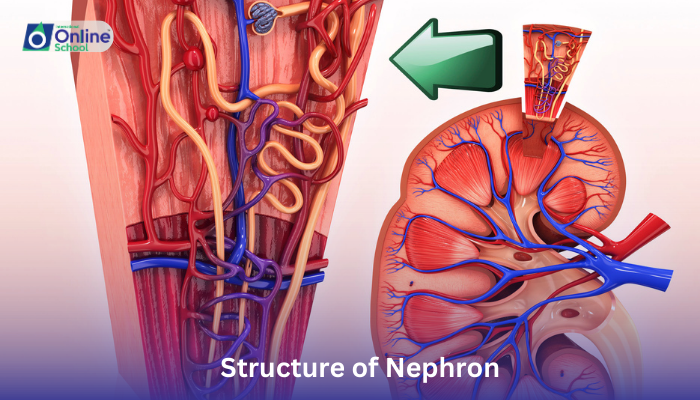
ii. Identify and describe the major components of the nephron, including the glomerulus, Bowman's capsule, proximal convoluted tubule, loop of Henle, and distal convoluted tubule.
iii. Explain the role of each component of the nephron in the filtration and reabsorption of solutes, forming urine.
iv. Appreciate the intricate design of the nephron and its contribution to the kidney's vital functions.
Introduction
The nephron, the microscopic unit of the kidney, is responsible for the intricate task of filtering blood, reabsorbing essential solutes, and excreting waste products. Understanding the structure and function of the nephron is essential for comprehending the kidney's role in maintaining homeostasis and regulating the body's internal environment.
i. The Glomerulus: A Filtering Marvel
The glomerulus, a capillary network located at the beginning of the nephron, is responsible for the initial filtration of blood. It consists of three layers:
Endothelial cells: The innermost layer, perforated with small pores that allow water and solutes to pass through, forming filtrate.
Basement membrane: A mesh-like structure that supports the endothelial cells and restricts the passage of larger molecules, such as proteins, into the filtrate.
Podocytes: Specialized epithelial cells that wrap around the capillaries, forming finger-like projections that further regulate the selectivity of filtration.
ii. Bowman's Capsule: The Collecting Cup
Bowman's capsule, a cup-shaped structure surrounding the glomerulus, collects the filtrate formed during the filtration process. It is lined with simple squamous epithelial cells that allow the passive movement of filtrate into the next segment of the nephron.
iii. Convoluted Tubules: Reabsorption and Secretion
The convoluted tubules, a series of interconnected coiled tubes, are responsible for the selective reabsorption of essential solutes, such as glucose, amino acids, and electrolytes, back into the bloodstream. They also play a role in the secretion of waste products, such as excess potassium and hydrogen ions, into the filtrate.
Proximal Convoluted Tubule (PCT): The first convoluted tubule, responsible for reabsorbing approximately 65% of the filtrate.
Distal Convoluted Tubule (DCT): The final convoluted tubule, involved in fine-tuning electrolyte balance and regulating blood pressure.
iv. Loop of Henle: A Countercurrent Multiplier
The loop of Henle, a U-shaped structure located between the proximal and distal convoluted tubules, plays a crucial role in concentrating urine. It consists of descending and ascending limbs that utilize a countercurrent mechanism to establish a concentration gradient between the medulla and the cortex. This gradient allows for efficient reabsorption of water and solutes, resulting in the production of concentrated urine.
v. Collecting Ducts: The Final Pathway
Collecting ducts, a network of tubes that extend from the distal convoluted tubule to the papillae of the kidney, collect urine from multiple nephrons and transport it to the ureters. They also play a role in modifying the composition of urine by reabsorbing water and certain solutes.
The nephron, with its intricate structure and coordinated functions, is a remarkable example of biological adaptation. Its ability to filter blood, reabsorb essential solutes, and excrete waste products is essential for maintaining homeostasis and ensuring the proper functioning of the body. Understanding the nephron's anatomy and physiology provides a deeper appreciation for the kidney's vital role in regulating the body's internal environment and maintaining overall health.
